
Haunted by Thoughts
I’m a ravenous note-keeper. I have scribblers1 and pens tucked away everywhere. Across my desk, in my backpack. The note-taking app on my mobile boasts a hefty chunk of the device’s memory. Thoughts and questions pop into my head to torment me, often at inopportune times. Topics vary. Storytelling. Heritage studies. Nature. How corporations injecting themselves into our entertainment has eradicated the value of the accessible arts. And, of course, ghosts.
In my relentless studies of ghostlore and the spectre-centric occult, I’m often intrigued, even perplexed, by certain curiosities. Most of them end up scribbled down. Here’s one thought I put down a while back in my Ghostlore Observations notebook:
Thinking on the potential existence of ghosts, I’ve come to believe that such a reality would lie outside of culture. Cultures simply attempt localized ways to explain phenomena as yet understood. Old cultures had religious and folk explanations for the sun, all of which are now obsolete. The same could eventually be the case for ghosts. If our honest goal is to explain the existence of ghosts, and explain what ghosts are, culture may prove unreliable to the endeavour.
Summarized: cultural views on ghosts are brilliant windows into beliefs, but they may not be of much value to research into genuine hauntings.
Expanding on my thoughts, ghosts often appear differently across cultures; however, if ghosts are real, differences in appearances, and in how they come to be, are unlikely. They would have to exist in the same way everywhere. Put bluntly, the ways in which different cultures describe ghosts, whether through lore or literature, film or fancy, are often products of old assumptions. As the great paranormal researcher, Peter Underwood, put it:
You have to appreciate that, if you go into this seriously, there is a great difference between the ghost of fact and the ghost of fiction. The wispy, transparent figure, with manacles around his ankle and his head under his arm, is strictly the ghost of fiction.
A Korean example is the female phantom, clad in white, hair unkempt and falling in strands over an unquiet face. This is the ghost of fiction. It makes for a great visceral image for storytelling, but it shares no similarity with genuine ghost encounters across Korea. Any claimed sightings of ghosts like this are questionable in an already disputable exercise.
Underwood goes on to say:
The real ghost, the true ghost - if there are such things - appear to be absolutely normal.2
But, then, if they don’t appear as they do in our folktales and fictions, how much more intriguing is it that ghosts are as mundane as a man sitting on a bench, a child running through a park, a woman strolling down the street? How many of us have encountered ghosts without even knowing it?
And that’s the kind of stuff I think about. I mark as much of it down as I can, ponder over it, then usually write about it. A neighbouring thought in my Ghostlore Observations notebook is one I’ve been looking into for a very long time:
What is the most haunted country on Earth?
…But We Can’t Say No
My memories of hearing about ghosts and hauntings stretch quite a ways back. Honestly, I don’t remember a time when I wasn’t spooked by the possibility of spectres. I had vivid, ghostly nightmares as a child, and I remember all of them. For me, these childhood fears and nighttime experiences were important to the formation of my interest in the paranormal.
One such ordeal that has never left me happened when I was about six or seven years old. My bedroom door opened into the hallway, and my bed faced the threshold in such a way that the foot of my bunk pointed straight down the hall. On this night, I was stirred awake. I sat up in bed, rubbed my eyes, looked out into that corridor, and saw an old man peering at me from the other end. He suddenly rushed towards me, trembling and shaking with an expressionless face. I screamed, which brought my father running.
I told him what I saw. And I blamed him for it. You see, it wasn’t just an old man I saw lumbering towards me, it was someone wearing a mask. My father owned a mask molded into the visage of an elderly fella. And I hated it. The mask’s uncanny valley terrified me. So, I was upset with my father for putting on the goddamn thing and charging towards me in the middle of the night. Of course, he didn’t actually do that, and wouldn’t have thought of doing it. It took some time before I was convinced it was a nightmare.
Another night, just a few years later, while our parents were out, I sat around the TV with my sister and brother. We watched Unsolved Mysteries, a show I loved and loathed in equal measure. One segment of that episode featured the Queen Mary, a ship famed for its alleged ghosts. At the end of the piece, host Robert Stack said, ‘Is the Queen Mary haunted? We cannot say yes… but we cannot say no.’
Sitting there on the couch, a pseudo-cool nine-year old, I responded aloud, ‘No. There, I said it!’ I was trying to convince myself that the Queen Mary wasn’t haunted, and that it couldn’t be haunted, because that would mean no where could be haunted. It was an effort of self-comforting, of reassuring myself there was nothing to be afraid of. It was useless, of course. I was still petrified by the possibility of ghosts.
My sister, the eldest and in charge that night of getting me off to bed, sent me to wash up. Except I didn’t want to go upstairs alone. My brother poked fun at me, as older brothers are wont to do, before I finally tore up the steps to the washroom. I splashed a bit of water on my face, brushed my teeth, and leapt under the covers. Literally. I slept with my head under my blankets until I was probably ten or eleven years old. Despite always being afraid to go to bed, I usually dozed off pretty fast. This night was no different.
Then the sound of shuffling footsteps. I heard someone walk into my bedroom. They stood by the side of my bed. They didn’t move. At first, I thought it was my mother or father arrived home, coming in to check on me. Still, they didn’t move. Whoever came in didn’t go back out. One of my tricks back then was to lift just enough of my blankets to make a peephole. I peered out. It was too small, I couldn’t quite see. Scenes from Unsolved Mysteries played back in my head, its theme crept through my inner ears. I built up courage, and with a quick inhale, tossed the blankets off and bolted up in bed.
No one was there.
But that wasn’t really comforting. After all, in times like that, nothing is just as frightening as something. I quickly tucked myself back in, half-suffocating beneath the covers, and eventually fell back asleep.
It was a nightmare. I dreamt the whole thing, like I tended to do when I was a kid. Understanding that those experiences weren’t the products of the supernatural helped shape my eventual cautious skepticism. Still, nightmares haunted me well into my early teens. And they were compounded by watching the likes of Unsolved Mysteries and In Search Of, and reading The Amityville Horror far too young3. But most of all, they were fed by the suggestion that I was born into the most haunted culture on Earth.
I don’t quite remember who said it the first time I heard it, but I do remember the casual seriousness with which the lines were spoken: Newfoundland is the most haunted place in the world.
There’s No Dark Like (Insert) Dark
I repeated the claim throughout my life. It was just obvious to me. There are more hauntings in Newfoundland than anywhere else on Earth. My belief in the statement was solidified by the numerous Newfoundland ghost stories I heard, most of them from my father. Even when I was very young, while we still lived in Ontario, I was convinced that no where could compete with the haunts of Newfoundland.4
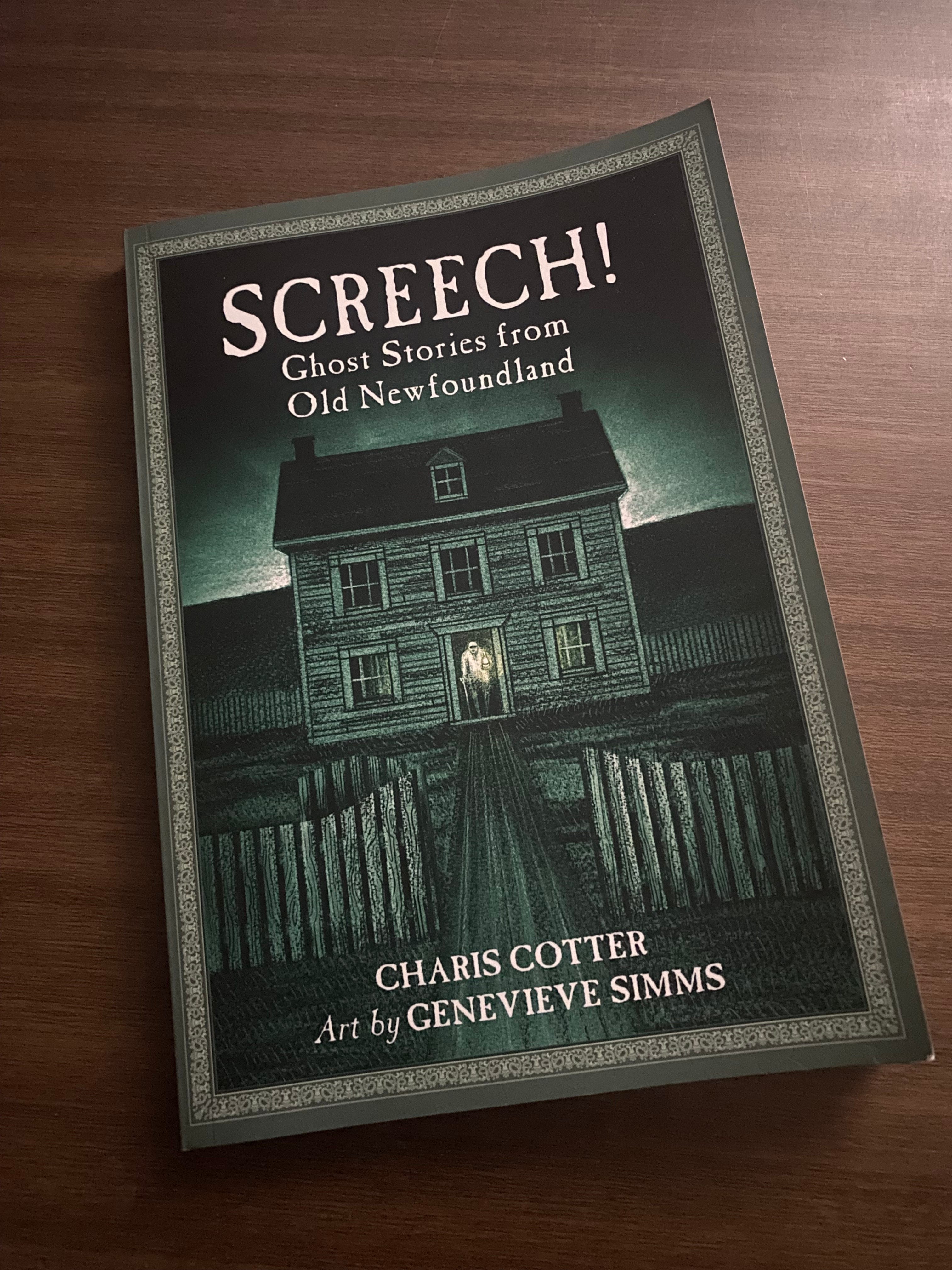
That was forty-some years ago, but the claim persists. In 2020, author Charis Cotter wrote Screech! Ghost Stories from Old Newfoundland. The book’s catch phrase, ‘There is no dark like the Newfoundland dark’, keeps alive the idea that Newfoundlanders are the inhabitants and inheritors of an unparalleled haunted landscape and culture. By extension, then, if Newfoundland is the most haunted place in the world, then Canada is the most haunted country.
As I grew and delved more deeply into the ideas of ghosts, thinking on the topic, devouring case studies, and conducting my own interviews and research, my opinion couldn’t help but change. The problem paramount to the claim of ‘the world’s most haunted place’ is that there’s no objective data to support it. After all, going on the aforementioned idea that many of us may have experienced ghosts without knowing it, we cannot lay down any concrete statistics. Generally, the accepted definition of ‘ghost experience’ involves things like vanishing figures, rattling doorknobs, bodiless footfalls, and the sort. But many genuine hauntings, perhaps even most of them, go unnoticed.
We also have one mammoth question that remains unanswered: what are ghosts? It’s difficult to determine the World Champion of Hauntings without even knowing what spooks are, how they form, and where they come from. There are theories, of course, especially in popular discourse. Trauma is perhaps the most oft quoted reason. For example, murder victims whose killers are never caught remain trapped in immaterial form, tormented and pining for justice. Also, events of unjust deaths, such as genocide or war, are said to produce hauntings. This is the very reason, as I’ve heard it said, that Cambodia’s Killing Fields, and as such, Cambodia itself, is the most haunted place in the world.
Shared national trauma giving rise to the greatest number of spooks gathered in one place has also been used to give the ‘most haunted’ accolade to Scotland. A few years back, Scottish parapsychologist Evelyn Hollow was asked in a news interview why Scotland can boast the claim. She replied:
When you look at it per capita, for the size of the country, and the level of phenomena that is happening, it’s incredible. You’ve got years of genocide, oppression, wars, social cleansing, and just some really horrific crimes being committed here. So, when you look at all of that trauma, and then you look at paranormal activity, it kind of starts to make sense as to why so many people report having paranormal experiences in Scotland.
That is almost verbatim the reason I’ve been told that Korea can call dibs on being the most haunted country in the world. Added to the Korean claim is han5, the word for shared cultural grief and melancholy, which folk belief suggests can give rise to ghosts.
Trauma may have a hand in the rise of restless phantoms, but, truth be told, I don’t much care for how trauma is often used as an explanation. When scrutinized through the lens of our question, to pinpoint the most haunted place on Earth, citing trauma as the reason also claims, either intentionally or unintentionally, the most traumatized people on Earth. It carries an air of competitive national anguish that leaves a bad taste in my brain.
Without doubt, every explanation of how or why ghosts would or could manifest is contentious. Interpretations range from lived trauma, restless souls with unfinished business, imprinted events of time somehow repeating on space, images from the infrared portion of the light spectrum, demons, and, of course, misidentification, wishful thinking, and hoaxes.
One metric that’s often used to locate the most haunted place on earth is the number of reports. Surely, the country with the most reports of hauntings is the answer. Yeah, not really. Unfortunately, this is wildly unreliable, especially because there’s no single global measurement or authoritative body that can accurately make such a determination. And the ranking lists that do exist vary considerably. Some data suggests England wears the creepy crown, with some getting even more specific, suggesting Amersham, a quick jaunt from London, is global spook central. Other data gives the nod to the United States. There’s also the certainty that most ghost reports worldwide are bogus. In my own research and interviews, I can say with confidence that most encounters did not happen. I argue that up to 99% of supernatural claims can be explained away rationally, or by revealing charlatans, grifters, and fibbers. That being the case, report data can only really indicate willingness to report, perhaps even cultural propensity to (want to) believe, and do not give a genuine answer to our question.
But, Anyway. The Most Haunted Country in the World Is…
I’m of the mind that, should they be real, ghosts exist in the same form and arise in the same way regardless of place. I’ve already said that culture and domestic views of historical hardship hinder honest research into ghosts. What’s more, the question itself is a hinderance. By every effort, suggestion, and measurement, there is no ‘most haunted country in the world’.
Until we know what ghosts are, the mystery is equal for us all. And that’s pretty exciting!
Still, I’ve come across so many bits of media that make the claim. I remain fascinated by every endeavour to not only answer the question, but to find it important enough to answer.
Below is a list of the some of the media that I’ve uncovered making claims that such-and-such a country is the world’s most haunted.
UK
TV
40 Minutes: Ghost Train (BBC2, 2 March, 1989). Early on, the documentary states: ‘There are more recorded apparitions seen in Great Britain and Ireland than in any other country in the world.’
Strange but True (season 1, episode 2; ‘Pete the Poltergeist’ segment). From the introduction: ‘There are probably more reported sightings of ghosts in the British Isles than anywhere else in the world.’
Haunted Britain (Channel 5, 2000). From the intro: ‘Britain is said to be the most haunted country on earth.’ The content was about Pengersick Castle.
Short Stories: Ghost Hunters (Channel 4, 1996). An interviewee, Randy Leebeck (sp), an American ghost researcher, said he was once told during a lecture that ‘you can’t be a proper ghost hunter if you haven’t been to England’; similar idea to ‘England is the most haunted country’. The content was about Littledean Hall.
The Proof is Out There: Shadow People Haunt These Homes (History Channel YouTube; 2024, video copyright lists 2025). In the intro, the host, Tony Harris, says ‘The United Kingdom, with its abandoned castles and ancient cemeteries, has been called the most haunted country in the world.’
The Town of Endless Ghosts Sightings (HauntTV YouTube; 25 October, 2025). This episode makes the claim for Amersham.
Social media
Indian YouTube channel Public Interest states that England is ‘the most haunted place in the entire world.’ The claim is based on Christian ceremonies and folk beliefs.
Books
In his book, Into the Occult, Peter Underwood says, ‘Ghosts and haunted houses have been reported from every civilization since the beginning of recorded history, although today there are more reported per square mile in the British Isles than anywhere else on earth.’
Czechia
Social media
YouTube channel ZeroPulse000 states Czechia is the most haunted country in the world. The video also states that Hoia-Baciu is one reason why Czechia is so haunted. The problem with that, of course, is Hoia-Baciu is in Romania.
Books
A book by G. Michael Vasey asks the question right in the title: The Czech Republic: The Most Haunted Country in the World? It’s repeated as a statement in the introduction: ‘The Czech Republic may just be the most haunted country on the planet!’
Japan
Social media
YouTube channel MyTravelEyes30 states Japan’s paranormal activity makes it the scariest place in the world. That’s essentially saying Japan is the most haunted country.
US
Social media
YouTube channel Ranker Guy says the US is the most haunted country in the world due to it having the most number of haunted sites.
Our Planet Earth TikTok ranks the US as the most haunted country on earth; there’s nothing said to explain the claim. The list goofs up by mentioning the UK as the second most haunted, then Scotland and Wales as 13th and 20th, respectively. I assume the video either meant England is second, or the creators don’t know their geography.
Premium Tours created the ‘Paranormal Activity Index’. They ranked the US as the most haunted place on Earth. Interestingly, the index associates UFO sightings with hauntings, but more broadly with paranormal activity. Several YouTube channels referenced this list, including Faultlinevideos and CarrietheOne.
YouTube channel Chedli says the US is the most haunted country based on ‘local folklore and the number of places that are known to be haunted.’
YouTube channel Kreeskie posted a video ‘The Most Haunted Places in the World’, with four entries. Each of the four were in the US. They ranked the Myrtle Plantation number one.
YouTube channel TopSarim lists the US as the most haunted country.
Check out the Unsolved Mysteries episode about the Queen Mary. Stack’s voice saying ‘…but we cannot say no’ is burnt into my brain.
Let me know your thoughts on the question
‘What is the most haunted country in the world?’
Scribbler is the Newfoundland term for notebook, particularly the kind used by students
From a British radio interview (1986)
It wasn’t until much later that I realized the Amityville Horror was a hoax. Great fun though!
I may or may not be planning a book about my family’s various supernatural experiences in Newfoundland. Stay tuned!
Han is written in Korean as 한. Han is often discussed as a uniquely Korean emotion, though this is a problematic idea in line with the competitive anguish I dislike so much.
It's a very interesting question, and I've thought about it multiple times since you first asked it.
If any place is truly the most haunted, maybe the places that have been inhabited by humans the longest should be the ones, unless ghosts or the trauma that caused them have an expiration date. It's so hard to separate the cultural aspect of ghosts from the potentially real, which would have to be universal, as you said. Any designation of a "most haunted" place involves a cultural bias, both of how ghosts are interpreted in that culture and how familiar we are with its traumas and stories.